
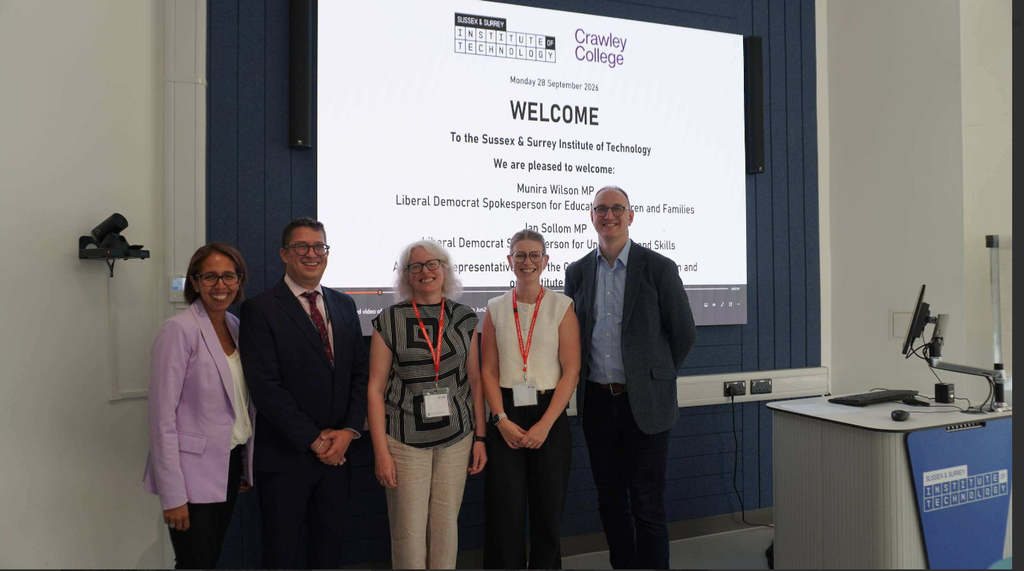
Munira Wilson MP and Ian Sollom MP, the Liberal Democrat spokespeople for Education, Children and Families and for Universities and Skills, visited the Sussex & Surrey Institute of Technology (SSIoT) at Crawley College to tour the new facility and discuss how more people can be recruited onto Level 4 and 5 technical routes.
They met students and staff, saw the engineering and digital ‘Learning Factories’, and joined a working lunch with employers, education partners and the Gatsby Charitable Foundation.
Munira Wilson MP said: “It’s brilliant to see this kind of facility here in Sussex that’s available to lots of young people who want to come and do technical and vocational training, working with local employers and providers right across the region. It’s been a really inspiring visit.”
A national ‘missing middle’
Only around 10% of adults in England hold a Level 4 or 5 qualification as their highest, compared with roughly 20% in Germany and 34% in Canada, despite up to 285 occupations at these levels. UCAS applications to Level 4/5 courses fell by around 12% between 2019 and 2023, from 46,725 to 40,920.
Partners identified several barriers to reversing this:
- Low visibility: There is no single, comprehensive list of Level 4 and 5 Higher Technical Qualifications (HTQs), unlike for Level 6 degrees, and many learners and advisers are unaware these routes exist.
- The ‘default degree’ effect: The three-year honours degree is still the route schools promote most, even though Level 4 and 5 qualifications offer good labour market returns and cost less.
- Funding uncertainty: The split between student finance and Advanced Learner Loans has made funding hard to navigate, and the delay to the Lifelong Learning Entitlement (now 2026/27) has added uncertainty for providers and learners.
- Provider viability: Small cohorts make some provision financially precarious, and providers must balance employer-designed standards against the flexibility needed to keep courses viable.
- Uneven employer engagement: Engagement is strong among large anchor employers, but Skills England’s 2026 Annual Skills Report highlights the need to simplify access to training and cut administrative barriers for SMEs.
Paul Rolfe, Director, Sussex & Surrey Institute of Technology, said: “Level 4 and 5 qualifications are the missing middle of our skills system, and employers across Sussex and Surrey continuously tell us of their challenges. We’re working with partners like Gatwick Airport and Roche Diagnostics to build the technicians and engineers the region needs, but too many young people and career changers never hear that these routes exist. We were delighted to show Munira and Ian what colleges, universities and employers can achieve together.”
Local demand for higher technical skills
The challenge is acute in Sussex and Surrey. The Sussex and Brighton Local Skills Improvement Plan reports that employers across sectors consistently highlight pressure in technician and mid to higher level technical roles, and expects demand for higher-level technical capability to increase over the next three years. The Surrey LSIP also points to a need to upskill technical roles and to improve diversity and inclusion across technical pathways.
SSIoT, a £15 million partnership led by Chichester College Group with the Universities of Sussex, Brighton and Chichester and Nescot, was designed to respond. It aims to supply the skills pipeline for Gatwick’s Northern Runway expansion, net-zero construction and the region’s growing digital economy, with employers including Gatwick Airport and Roche Diagnostics among its supporters.
Ian Sollom MP said: “I think what’s really impressive is to see how the ecosystem of post-16 education is working in Sussex and Surrey. I think it’s really good to see different education providers from Higher Education and Further Education coming together and working with employers to make an offering that’s really good for the young people of the region.”
Why it matters nationally
The government wants two-thirds of young people to reach higher-level learning by 25, including 10% through higher technical education or apprenticeships by 2040, nearly double today’s rate. Skills England estimates around 900,000 more skilled workers will be needed in priority sectors by 2030. Mature learners are around twice as likely as 18-year-olds to apply for Level 4/5 study, making these qualifications a significant lever for social mobility and regional equity.
Ginny Page, Director of Programmes, Gatsby said: “There’s currently a big focus on technical qualifications starting at age 14, but it’s important to think about what comes next, and how technical pathways extend into higher education, through universities or FE colleges, and into the workplace. National education and skills policy needs to support regions like Sussex and Surrey, and partnerships like the Institute of Technology, to deliver these opportunities for learners in their community and provide skilled people and economic growth for local employers.”
Find out more
Employers and education partners interested in working with the Sussex & Surrey Institute of Technology, supporting learners or developing technical skills can contact:
Tim Chester-Williams BEng
Head of Sales
M: 07881 335821
E: tchesterwilliams@crawley.ac.uk
Work with the Sussex & Surrey Institute of Technology: sussexsurreyiot.ac.uk/employers/
Learners can explore courses and progression opportunities at Crawley College: Explore courses at Crawley College