
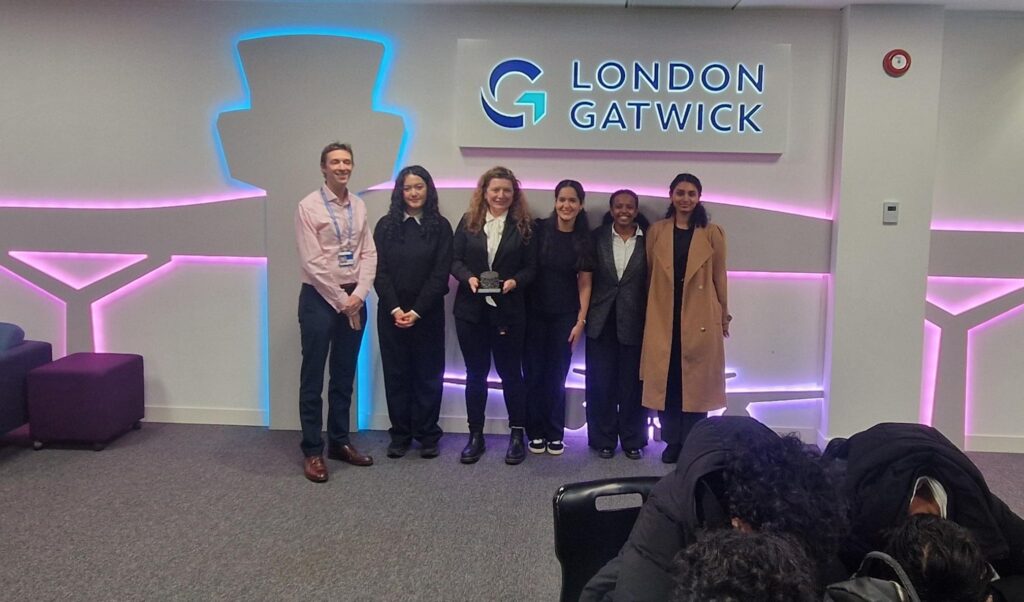
Students from Crawley College, Nescot and university partners of the Sussex & Surrey Institute of Technology (SSIoT) came together at London Gatwick Airport on Tuesday 17 November 2026 to tackle a real-world aviation sustainability challenge.
The first London Gatwick and SSIoT Innovation Challenge, held at the airport’s STEM Centre, brought together students studying engineering, IT and related technical subjects to develop innovative solutions to a genuine operational challenge. Designed and organised by London Gatwick, with participation and support from SSIoT education partners, the event demonstrated the value of collaboration between colleges, universities and employers in developing technical knowledge, practical skills and industry experience.
SSIoT is a partnership led by Chichester College Group, bringing together the University of Sussex, University of Brighton, University of Chichester and Nescot, alongside industry partners including London Gatwick.
A real-world aviation challenge
The event, titled ‘Flight to the Future – Sustainability in Aviation at Gatwick’, focused on Reduced Engine Taxiing (RET), where aircraft operate with fewer engines while moving around the airfield to reduce fuel consumption and greenhouse gas emissions.
Although airlines already use this practice, Gatwick currently relies on information supplied through airline surveys to estimate how frequently it occurs. Without reliable information, the airport must use conservative assumptions when calculating emissions, potentially overestimating actual fuel consumption.
Gareth Sear, Business Engagement Lead at London Gatwick, welcomed participants, followed by Paul Rolfe, Director of SSIoT and Associate Principal for Employers and Stakeholders at Chichester College Group, who highlighted the value of real-world learning and opportunities for students to engage directly with employers.
Mark Edwards, Gatwick’s Head of Sustainability, then introduced the airport’s Decade of Change sustainability strategy and outlined the challenge: to develop innovative ways of identifying how many aircraft engines are operating during taxiing, enabling Gatwick to improve its emissions reporting.
University partners support student innovation
Working in teams of five, students participated in a series of workshops delivered by academics from three SSIoT university partners. Dr Henry J Dore from the University of Sussex introduced problem definition and systems thinking, including root-cause analysis and the ‘5 Whys’ technique. Dr Usman Usman from the University of Brighton led a workshop on innovation and creative thinking, encouraging students to explore alternative approaches and develop potential solutions. Following an initial period of teamwork and idea development, Roger Holden from the University of Chichester delivered an afternoon workshop on creating and delivering the ‘perfect pitch’, helping students structure and communicate their ideas effectively.
Supported by university and college staff and the London Gatwick team, the students developed and refined their proposals before delivering five-minute presentations to a judging panel comprising Gatwick representatives and Fiona Anderson, Innovation Director at Crawley Innovation Centre.
The experience also supported students’ personal development, encouraging teamwork, communication, problem-solving, learning from peers and working to individual strengths under time pressure.
Crawley College students develop engineering solutions
Crawley College was represented by two teams of second-year T Level students studying IT, mechanical engineering and electrical/electronic engineering.
Both teams proposed using thermal imaging technology to identify heat signatures from operating aircraft engines, potentially adapting existing airport cameras or installing additional infrared monitoring equipment along taxiing routes. They also explored other approaches, including acoustic sensors to detect engine activity.
The students considered practical challenges including distinguishing engine heat from other sources, such as aircraft tyres, and accounting for environmental conditions including winter de-icing operations.
Their proposals demonstrated how engineering and digital technologies could be combined to address a complex industry problem.
SSIoT also supported the event with student research and presentation materials, engineering and digital course information, and a display showcasing facilities at Crawley College, including its recently introduced Festo Didactic Industry 4.0 automation and manufacturing equipment.
University of Brighton teams take top prizes
First place was awarded to the University of Brighton’s STEP Lab team, whose proposal involved a network of vibration sensors powered by existing airfield electrical infrastructure to provide more reliable monitoring of reduced-engine taxiing.
A second University of Brighton team secured second place, while the winners received a distinctive award incorporating an original core sample from Gatwick Airport’s main runway.
Reflecting on the event, Gareth Sear, Business Engagement Lead at London Gatwick, said: “It was inspiring to see students tackle a real aviation sustainability challenge with such creativity, professionalism and confidence. Beyond the innovative solutions developed on the day, the challenge gave students the opportunity to apply their skills in a real-world environment, work alongside industry and education professionals, developing teamwork, problem-solving and communication skills that employers value. The quality of ideas on display gives me real confidence in the future talent coming into our region and our industry.”
Strengthening education and industry partnerships
Paul Rolfe, Associate Principal for Employers and Stakeholders at Chichester College Group and Director of SSIoT, added: “This challenge provided a fantastic opportunity for students to work on a real-world sustainability issue facing one of the UK’s most important transport hubs.”The enthusiasm, creativity and professionalism shown by the students throughout the day were incredibly impressive, and we’re proud to work with partners who are helping to inspire the next generation of engineers, technologists and sustainability leaders.”
The Innovation Challenge provides a model for future collaboration between SSIoT and other industry partners, connecting education with genuine employer challenges and helping students develop the technical and professional skills needed in the workplace.
To find out more about the Sussex & Surrey Institute of Technology, visit https://www.sussexsurreyiot.ac.uk/
For information about T Levels at Crawley College, visit https://www.crawley.ac.uk/study-with-us/subjects/t-levels/