
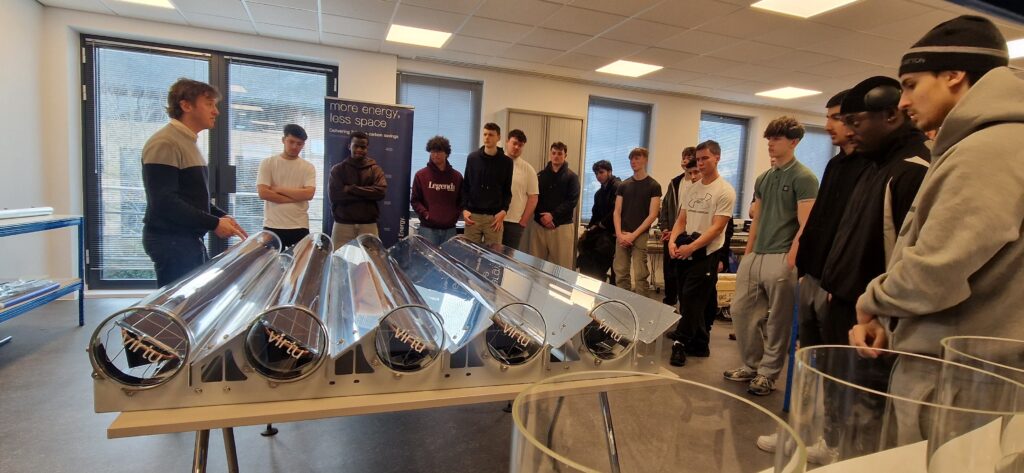
In January 2026, engineering students from Crawley College, studying on programmes aligned to the Sussex & Surrey Institute of Technology (SSIoT), visited Naked Energy at the Crawley Innovation Centre within Manor Royal to learn about low-carbon heat and solar thermal engineering.
Naked Energy is an innovative British solar thermal and hybrid solar technology company whose high-density Virtu systems are used in both commercial and residential settings with consistent heat demand, including large showcase projects such as the British Library in London. The company is a hands-on engineering-led business focused on decarbonising heat and supporting local energy resilience. Further information is available at www.nakedenergy.com. The students were welcomed by the Naked Energy team including Alex Mellor, Head of Technology Applications.
The visit gave students direct insight into the engineering and technology behind solar thermal and hybrid solar systems used in commercial and industrial buildings. Discussions focused on the technical challenge of decarbonising heat, which represents the largest proportion of energy demand in most non-domestic buildings. Engineers explained how prioritising heat generation and whole-system integration enables significant reductions in gas use and associated carbon emissions. In some applications, this approach can deliver efficiencies of up to three times those of more conventional solutions.
Naked Energy’s engineers outlined the technical and system design considerations involved in developing and deploying these technologies, including:
- heat-led system design reflecting real building energy demand
- integration of solar thermal and hybrid systems with existing building services
- retrofit solutions for existing premises rather than new-build-only approaches
- whole-system optimisation rather than component-level efficiency
The session also explored how modelling and data are used to support system design and commercial decision-making. This included:
- use of Naked Energy’s in-house software platform
- modelling how solar thermal or hybrid systems could be added to existing buildings
- simulation and comparison of different system configurations
- optimisation of system size, layout and performance
- calculation of expected heat output, energy savings and carbon reduction
- quantified outputs used to support technical and investment decisions before installation
Over the past seven years, Naked Energy has grown from around seven employees to approximately thirty-five, with the majority of roles being engineering and technology focused. The team also outlined the range of job roles involved in developing and scaling the business, including:
- product engineering
- manufacturing and production engineering
- systems design engineering
- installation and technical support
- software engineering and data modelling
- business development and customer support
- marketing, partnerships and management
We asked Alex for some personal advice to engineering students, he advised not to narrow their options too early, highlighting the value of gaining exposure to different areas of engineering before specialising. Also mentioning the importance of understanding how products move from design through testing, certification and manufacture, and how this process underpins real-world engineering applications.
For students, the session helped clarify the range of routes into the sector, including placements, internships and apprenticeships, and the value of getting hands-on experience alongside formal study. The visit reinforced how different the wide variety of engineering functions connect to future roles and progression opportunities, which link to the technical pathways available through SSIoT. SSIoT offers clear progression routes that support entry into engineering, digital and technical roles across low-carbon energy, advanced manufacturing and related sectors. These pathways include:
- Level 3 technical study providing core engineering knowledge and practical skills
- Levels 4 and 5 higher technical qualifications and apprenticeships supporting progression into technician and junior engineering roles
- degree-level study and higher apprenticeships enabling progression into systems design, software, product engineering and leadership roles
- upskilling and retraining routes for those already in work supporting progression into specialist technical or management positions
By combining technical study with employer engagement and real-world exposure, SSIoT helps learners build the skills, industry understanding and progression opportunities needed to move into skilled employment. Employer visits such as this are a core part of SSIoT’s approach, helping learners connect technical study with industry practice and understand current employer expectations.
Contact: Tim Chester Williams, Head of Sales – SSIOT. Email: tchesterwilliams@crawley.ac.uk