
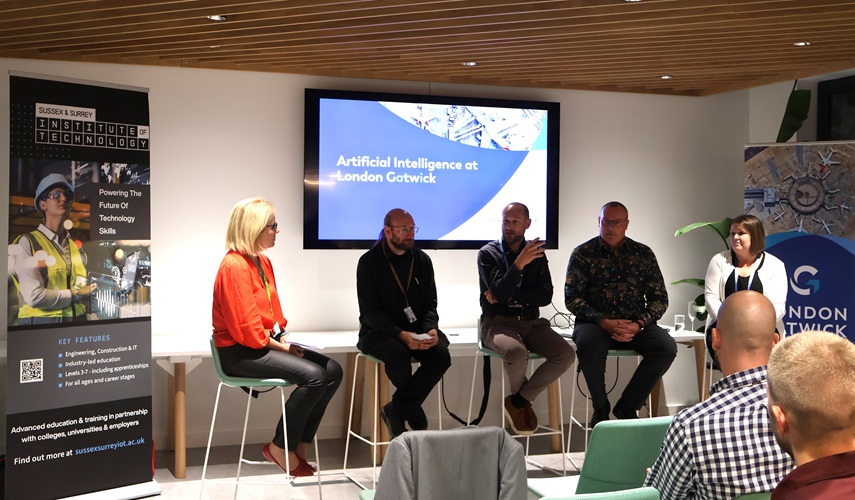
How does an airport handling thousands of people, aircraft movements, vehicles and operational decisions every day use artificial intelligence in practice?
That was the focus of ‘AI Beyond Large Language Models (LLM): Practical Applications for Your Business’, held at Crawley Innovation Centre in Manor Royal on 22 September 2026.
The event was a partnership between Crawley Innovation Centre, London Gatwick Airport and the Sussex & Surrey Institute of Technology (SSIoT) at Crawley College, with the University of Sussex contributing to the panel discussion.
Fiona Anderson, Innovation Director at Crawley Innovation Centre, opened the event by outlining the centre’s role in helping businesses grow through workspace, product development facilities, events and partnerships.
Gareth Sear from London Gatwick Airport introduced the airport team and the scale of the operation. London Gatwick contributes around £5.5 billion to the UK economy, supports more than 22,000 jobs directly on the airport and serves more than 230 direct destinations.
He also highlighted Gatwick’s focus on developing the next generation of technical talent. London Gatwick Airport is an SSIoT partner and will work with Crawley College students on a technology challenge in November.
Gareth introduced Tim Paterson, Innovation Lead, Joanna Henderson, Head of IT Products and Platforms and Keith Greenaway, Digital Workplace Manager. Dan Creed, Assistant Professor in Computer Science at the University of Sussex, joined them as a panel member.
Six forms of AI
Tim began by setting out six areas of ‘Narrow AI’: Generative AI, Natural Language Processing, Machine Learning, Computer Vision, Expert Systems and Robotics Systems.
Microsoft Copilot provided a familiar starting point. Gatwick had around 1,000 active Copilot users from approximately 2,500 employees at the time of the presentation, using it for tasks including written communication, summarising information and analysing data.
Keith also discussed its potential to reduce ‘digital debt’, the accumulation of routine digital work that consumes employees’ time. Joanna described some staff as already “taking flight” with AI, while training and digital leaders or ‘super users’ are helping others build confidence.
Legal and HR provided further applications. AI can support document review, contract analysis and drafting, while in HR Gatwick discussed skills matching against CVs and job advert creation, including the potential to reduce human bias during initial matching.
Natural Language Processing and Machine Learning are also changing how staff access business data. Instead of relying on multiple fixed dashboards and reports, authorised users can ask questions of shared data through natural language interfaces and extract the information they need. A prototype within the commercial team began with five users and had grown to around 90 after six months.
Data quality, governance and security remain essential. Data leakage was identified as a risk, with Microsoft Purview among the tools referenced for protecting organisational data.
One presentation slide summarised the relationship clearly:
“AI provides recommendations, while humans provide judgement.”
Computer vision and airport operations
Computer Vision and Machine Learning are being applied directly to aircraft turnaround.
Preparing an aircraft for its next flight involves a tightly timed sequence of activities including baggage handling, cleaning, catering, fuelling and engineering support. Gatwick compared the process with a Formula One pit stop, with multiple operations taking place against the clock.
A visualisation showed how cameras and operational data can identify individual ‘turn events’, record when activities start and finish and improve predictions of when an aircraft will be ready for pushback and departure.
If an aircraft will not be ready for fuelling at the expected time, for example, a fuel vehicle could potentially be redirected rather than waiting at the stand. Vehicle tracking and geofencing can add further information about available resources.
More accurate information about aircraft readiness can support better deployment of staff, vehicles and equipment to help ensure on time turn arounds and departures.
Gatwick is also exploring technology to give passengers requiring assistance greater independence, including autonomous mobility systems able to navigate through a busy terminal.
Robotics is already in operational use through Gatwick’s robotic parking system, which moves and positions vehicles automatically to use existing parking space more efficiently.
What should organisations use AI to do?
During the Q&A, Dan Creed raised a wider question: organisations need to consider not only what AI can do, but what they should use it to do.
The discussion covered staff adoption, training, business cases, return on investment, governance and security. Gatwick explained that technology suppliers and partners work to high security standards and relevant certifications, supported by the airport’s own cyber specialists and internal controls.
Moving from a successful pilot to full operational implementation can also be difficult, particularly where new AI applications need to work alongside established or legacy systems.
Preparing students for an AI-enabled workplace
Dan emphasised the continuing importance of underlying subject knowledge. Students need enough understanding to recognise whether AI-generated information is accurate, appropriate or wrong and to judge when AI is the right tool for a task.
AI coding assistants also illustrate how roles may change. Opportunity remains for people who understand the wider system, can structure projects, assign the right skills and tools, test outputs and manage delivery.
The University of Sussex offers the Data Science and Artificial Intelligence (Level 7 apprenticeship) MSc, providing a higher-level route into specialist AI and data skills.
Chichester College Group also offers the AI Leadership – AI Strategy and Opportunity – Apprenticeship Unit, available through its apprenticeship provision including Crawley.
Nick Thorp, Marketing Manager at the Sussex & Surrey Institute of Technology, said: “I would like to thank everyone who contributed to the event. One of the things I particularly appreciated was the way London Gatwick set out six distinct forms of AI and then showed, through real examples, how they are being used across airport operations, including both the benefits and the challenges. Engagement with employers and university partners is essential to SSIoT. We want our learners to be as well prepared for the workplace as possible, including using AI effectively, responsibly and confidently, and working with employers wherever possible to inform best practice.”
Practical points from the panel
At the end of the discussion, Fiona Anderson asked the panel what businesses should focus on following the event. Their advice included having a clear AI policy, investing in staff training and education, understanding the problem or opportunity before selecting technology, developing a clear business case and ensuring good data quality, governance and security.
Fiona said: “Crawley Innovation Centre was thrilled to be part of the AI Beyond Large Language Models (LLM) event, alongside our ongoing partners and collaborators, London Gatwick, the Sussex & Surrey Institute of Technology at Crawley College and University of Sussex. The event was an important moment for us all to take a step back and gain a better understanding of the impact AI can have on businesses and our professional lives. Rather than choosing to ignore it and get left behind, the event successfully helped address how we can all learn from each other’s experience of AI to drive productivity, innovation, business value and create collaboration opportunities.”
Further business events and co-working opportunities are available through Crawley Innovation Centre.
Employers interested in AI training or working with the Sussex & Surrey Institute of Technology, Crawley College and university partners can find out more about courses and opportunities to collaborate here: SSioT website.
Or contact us directly: Tim Chester-Williams Head of Sales at SSIoT: tchesterwilliams@crawley.ac.uk