
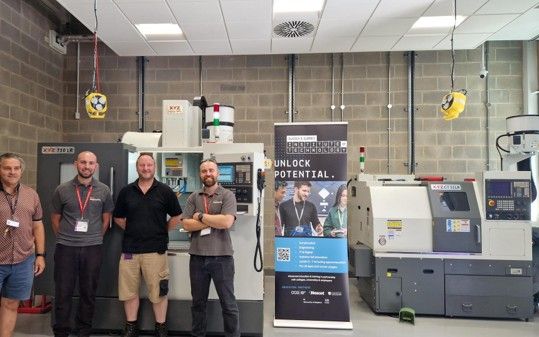
A new alliance between Kiyo Engineering, Crawley College and the Sussex & Surrey Institute of Technology combines T Level work experience, specialist training and industry expertise.
T Level students at Crawley College will gain work experience at Kiyo Engineering as part of a new alliance with the Sussex & Surrey Institute of Technology (SSIoT). Kiyo will also support the CNC machining systems in the SSIoT building at Crawley College, sharing current industry expertise with the college.
The SSIoT building at Crawley College has specialist engineering workshops equipped with CNC machining systems. These give students the time and space to develop practical machining skills, from setting up and proving jobs to producing and checking precision components.
Kiyo Engineering, based near Redhill, is a precision engineering company specialising in CNC machining, bespoke CAD design, metal fabrication and welding. It brings a commercial engineering environment where machining skills are applied to live customer work, alongside the knowledge and experience of people working with CNC technology professionally.
The fit between the two organisations is straightforward. Crawley College provides a training environment, specialist equipment and students who have already chosen to develop engineering skills. Kiyo provides current CNC expertise and a working environment where those skills are applied commercially.
Kiyo has already supported activity at Crawley College, including the Careers Fair held at the SSIoT building in April 2026. Operations Manager Josh Taylor attended the event, with Managing Director Bernard Wilson also visiting during the day.
The plan is that students will do T Level work experience at Kiyo, alongside the company’s support for the CNC systems in the college workshops.
From Training to the Workplace
CNC, or computer numerical control, machining is fundamental to modern engineering and manufacturing. CNC machines use programmed instructions to carry out processes such as milling, turning and drilling, allowing precision components to be produced quickly, accurately and repeatedly.
The machinery can work at speed, but setting it up properly requires knowledge, judgement and experience. Before production begins, a machinist may need to select and set tooling, secure the work correctly, establish machine offsets, check or adjust a program and inspect the first component produced.
At Crawley College, students can take time to understand the machinery, practise setting up and proving jobs, make adjustments and learn from the process. Training can take place without the commercial pressure of taking a production machine out of use.
At Kiyo, students will be able to see how those same skills are applied in a working precision engineering business, where the machinery is being used to produce real work for customers.
Kiyo and the SSIoT workshops also use CNC machinery from the same manufacturer. Kiyo’s additional support for the machining systems at Crawley College will allow current industry knowledge to feed back into the workshop and help the college optimise its use of the equipment for training.
So the SSIoT and Kiyo environments complement each other particularly well.
Sharing Skills and Experience
Dave Fairburn, Deputy Head of Learning at Crawley College, helped establish the new relationship with Kiyo Engineering. Dave already knew Kiyo Workshop Manager Joe Hicks because he taught Joe machining when Joe was a college student, including on traditional equipment such as lathes.
Joe went on to build a career in engineering and now works extensively with CNC machining. He understands first-hand the value of technical training and where those skills can lead.
Through the new relationship, Kiyo can share its current machining knowledge with the college and support its CNC capability. It will also work with students who have already chosen engineering, are developing relevant technical competence and have demonstrated an interest in the industry.
That interest can be valuable to an employer. SSIoT has seen something similar through its recent work with Air Atlanta Aviaservices, where feedback on T Level placements highlighted the students’ enthusiasm, questions and willingness to understand the work.
For students, Kiyo adds valuable workplace experience to the skills being developed at college. For Kiyo, the relationship provides a connection with people already building skills relevant to the business and who could become part of its future workforce. The relationship therefore works in both directions.
Developing the Skills Needed by Industry
The alliance comes at a time when manufacturing employers continue to report significant skills shortages. Make UK’s 2026 *Shape of British Industry* research found that half of manufacturers see skills shortages as their biggest barrier to growth.
There is a particular challenge as experienced engineers and machinists retire. Their knowledge of machinery, tooling, materials, tolerances and problem-solving is developed over many years, making the transfer of practical skills to a new generation increasingly important.
CNC machining can lead to a range of skilled careers, with experienced roles attracting competitive salaries. The National Careers Service currently identifies CNC machining as a skilled engineering and manufacturing career, with progression as experience develops.
The relationship is also timely in the wider discussion around technical education. In July, Prime Minister Andy Burnham announced plans to give technical education greater parity with academic routes and strengthen connections between students, employers and the industries that need their skills. Engineering is among the areas specifically identified.
For SSIoT, this the concept in action. Bringing education and employers together around higher-level technical skills is central to the Institute of Technology model. The new Kiyo relationship is a practical example of what that looks like locally: T Level students gaining relevant work experience, industry expertise supporting college training and employers connecting directly with people developing the skills their businesses need.
Can you help offer work experience, mentoring or an apprenticeship? Please get in touch to discuss. Tim Chester-Williams: tchesterwilliams@crawley.ac.uk