
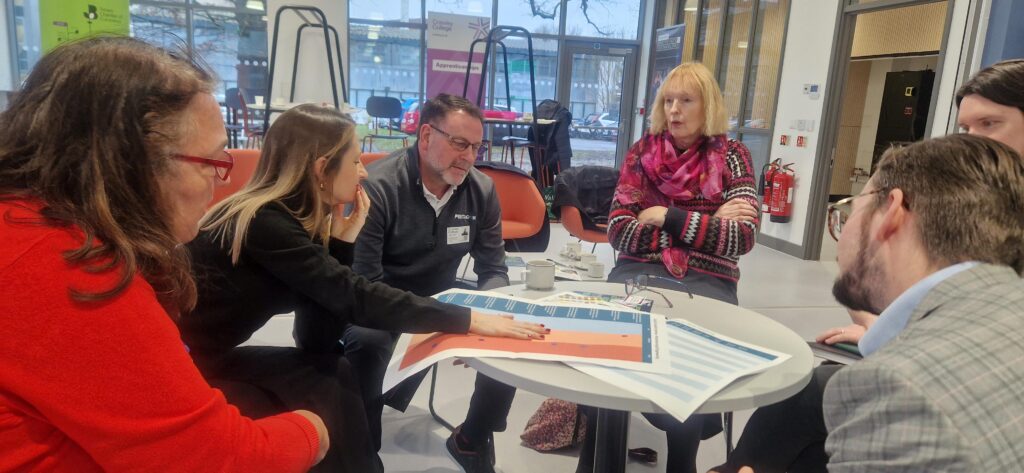
On January 13th 2026 we were honoured to host the Sussex Chamber of Commerce Engineering & Advanced Manufacturing Across Sussex, a Local Skills Improvement Plan (LSIP) event presented by Melanie Butcher, bringing together employers, educators and sector partners from across the region.
Across three hours of discussion, businesses from engineering, advanced manufacturing, water infrastructure and related sectors shared practical insights into the skills they need now and how those needs are changing. A clear message emerged throughout the event: employers must play an active role in shaping the skills system if it is to deliver the people and capabilities they require.
Skills as the defining factor
Employers consistently emphasised that skills remain the central concern for recruitment and growth. This includes technical competence, but also the wider skills needed to operate effectively in modern engineering environments.
Examples raised included project-based working, where individuals can scope a problem, manage time and resources and deliver outcomes; collaboration across teams and disciplines; digital confidence with systems, data and production technologies; and the ability to adapt as processes and expectations evolve.
Several employers noted that these skills are often best developed through applied learning, industry engagement and real-world problem solving.
The role of T Levels and apprenticeships
There was a notably positive view of T Level students, with many employers reporting strong experiences of hosting placements. T Levels were seen as a valuable route into engineering, providing learners who are motivated, workplace-aware and able to contribute meaningfully from an early stage.
In many cases, students were offered continued employment, apprenticeships or progression to further study at Level 3 and Level 4. Employers stressed that apprenticeships should not be viewed as an obligation, but as a long-term investment that supports workforce development and succession planning.
Higher-level skills and problem-solving
Employers also highlighted the value of students at higher levels, particularly Levels 7 and 8, who can focus on specific business challenges. When aligned with real organisational needs, these projects can deliver tangible benefits, such as new systems, improved processes or more efficient ways of working.
Students were described not simply as learners, but as a valuable asset, capable of making a meaningful contribution while developing advanced skills.
Responding to skills loss and technological change
A recurring theme was the gradual loss of traditional skills as experienced staff retire. Employers acknowledged the need to address this through both knowledge transfer and investment in new technologies, such as CNC machinery, automation and digital production systems.
However, technology alone is not the solution. Operatives still require high-quality training to use, maintain and optimise these systems safely and effectively. The Sussex & Surrey Institute of Technology is well placed to support this, with advanced manufacturing facilities including CNC equipment that enable industry-relevant, practical training.
Green skills, standards and sustainability
Environmental considerations also featured in discussions, particularly around growing expectations to understand and demonstrate environmental impact. Employers referenced increasing awareness of standards such as ISO 14001 and the role of life cycle assessment in manufacturing and infrastructure projects.
These requirements are shaping skills needs, from data handling and reporting to operational decision-making, and reinforce the importance of collaboration between employers and training providers.
Leadership, culture and changing expectations
Beyond technical capability, employers spoke about the importance of leadership and organisational culture. Developing technical skills does not automatically translate into effective management, and leadership requirements continue to evolve as workforce expectations and social norms change.
Employers highlighted the need for leaders who can manage complexity, support diverse teams and foster positive workplace cultures.
New routes into employment
Many employers described recruiting in new ways and offering a broader range of routes into engineering careers. This includes apprenticeships, T Levels, career changers and supported pathways, helping employers benefit from a wider mix of skills and perspectives.
Working together
A central message throughout the event was the need for employers to work closely with training providers. Employer input is essential in developing programmes that are relevant, impactful and responsive to real business needs, as well as in inspiring excellence among learners.
Within devolved areas of the UK, employers and providers have opportunities to make better use of adult learning funding and more agile approaches to skills delivery. This includes short, focused training designed to address specific skills gaps quickly, alongside longer-term qualifications.
As Melanie Butcher noted during the event, this is the time to have conversations with training providers, including local colleges and the Sussex & Surrey Institute of Technology. Not only about qualifications, but also about short, targeted training that can make an immediate difference.
If you are an employer looking to shape the skills pipeline or develop your workforce, we encourage you to speak with your local college or training provider. Working together is how engineering skills and knowledge will continue to thrive across Sussex and Surrey.
Contact: Tim Chester Williams, Head of Sales – SSIOT. Email: tchesterwilliams@crawley.ac.uk